People say the main event of a wedding is the ceremony. The vows. The rings. The kiss. This is a beautiful opinion. It is also, in many places, completely wrong. The main event is the food, and everyone in the hall knows it.
This is the story of a wedding where the real contest took place not on the dance floor, but at the buffet table.
The Early Arrivals
The invitation said 11 a.m. By 9:30, a small group of guests had gathered near the gate. They were dressed beautifully in matching fabric, with hair carefully done and expressions of calm innocence. “We are just here to support the couple,” said one of them. She was holding a large handbag, which seemed suspiciously roomy.
These early arrivals had a secret code. They would nod at each other, find seats near the kitchen door and begin a long conversation about the weather. They did not mention food. They did not look at the kitchen. They simply happened to be sitting in a place where smell and sound could reach them first.
“We came to see the decoration,” said another, fanning herself with the programme. The decoration was lovely. But she was not looking at it. She was looking at a large pot being carried past.
The Fashion Parade
As the hour approached, the hall filled with colour. There were gowns with sleeves wide enough to cause aviation concerns. There were caps tied with great precision, and shoes so shiny that they reflected the ceiling. Every guest walked in as if on a runway, pausing to let the photographer capture their good side.
“Smile!” called the photographer, and fifty people smiled at once. Then he said, “Again!” and fifty people smiled again, with slightly less patience. By the fourth round, a few of them had begun to wonder whether the photographer was also on the buffet schedule.
The bride arrived. Applause rolled across the hall. The groom wiped a tear. And at the back, someone whispered, “Is it time to eat?”
The Programme and the Pot
The ceremony was beautiful. The prayers were sincere. The speeches were polite and, mercifully, short. But every guest, deep down, was watching something else: the table at the far end of the hall, covered with silver dishes, each with a lid.
Whenever a lid moved, a ripple passed through the crowd. When a waiter carried out a tray of fried chicken, there was a collective intake of breath. When someone coughed, six people looked toward the kitchen. It was a hall of well-dressed hunters.
The MC, a calm man named Mr. Bayo (who has appeared in other stories), gave a short announcement: “Ladies and gentlemen, the food will be served after the cutting of the cake.” Several guests nodded politely. Several others began to plan.
The Silent Race
At last, the moment arrived. “Ladies and gentlemen,” said the MC, “please enjoy the meal.” There was no stampede. A Nigerian wedding is far too dignified for that. Instead, there was a quiet, rapid, elegant walk that could have been an Olympic sport.
The guests moved with the grace of dancers and the focus of a championship team. They glided between tables, pausing only to say “Excuse me, ma” and “Sorry, sir” before overtaking in a smooth curve. Someone’s grandmother passed three younger relatives without breaking a sweat. A man in a flowing agbada moved so fast his sleeves created a small breeze.
By the time the first plate was filled, the queue stretched across the hall. And in that queue, a delicate etiquette began.
The Rules of the Buffet
There are unwritten laws at the buffet. You never take the last piece of meat without a polite pause. You never take more than your table partners. You never, ever, look at someone else’s plate and comment. These laws are older than the wedding itself.
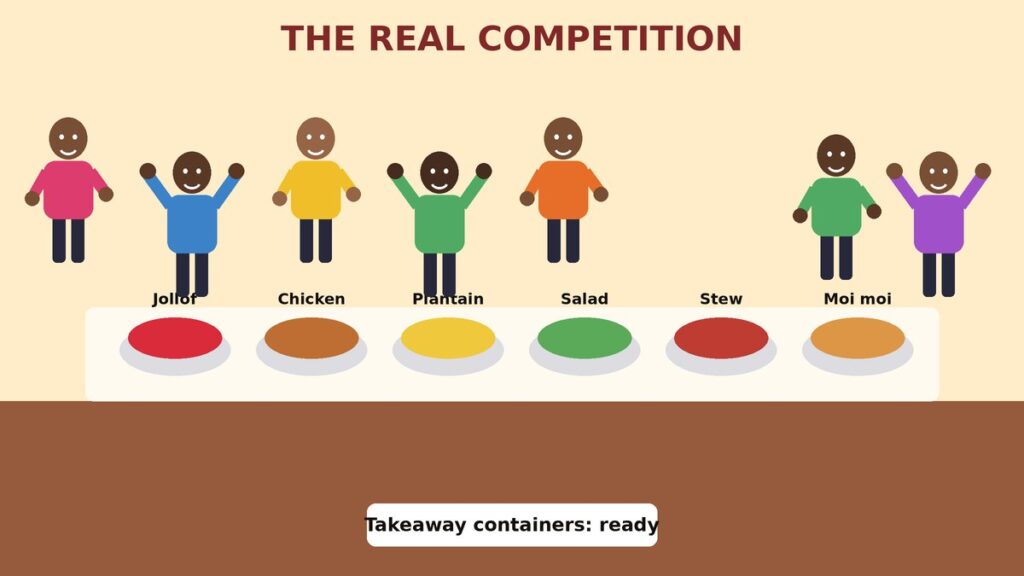
Still, there are loopholes. One guest took a tiny spoon of jollof and then returned for a larger spoon “to try the flavour”. Another took a small piece of chicken and came back for “a second opinion”. An uncle in the corner had somehow collected three plates, claiming that two were for his wife and one was for his “sick brother”.
His wife was sitting beside him with her own full plate. When asked about the sick brother, he said, “He is very sick.”
The Takeaway Operation
As the party drew to an end, a quiet, organised operation began. From handbags came small containers. From pockets came plastic bags. Even the elegantly dressed lady with the roomy handbag, who had arrived at 9:30, revealed a neat stack of aluminium foil.
“For the children at home,” she said to nobody in particular.
The bride’s mother noticed, smiled and waved a waiter over. “Please give them a little extra. Let nobody go home hungry.” It was a generous gesture. It was also the moment when the entire hall sighed in relief and produced even more containers.
By 6 p.m., the dishes were empty, the music was soft and the photographer was eating a plate of rice in the corner. The groom danced with his new wife. The guests, full and happy, waved their goodbyes. And the lady with the roomy handbag walked out, carrying a small, warm mountain of leftovers and the calm expression of a person who had done no wrong.
The couple were married. The families were united. And the jollof, everyone agreed, was excellent. Which proves what every Nigerian knows: love is beautiful, but love with rice is unforgettable.