
Every group of friends has one. He was an ordinary person last month. He ate rice, wore normal shoes and complained about fuel prices like everyone else. Then he made one small investment, it went up, and overnight he became a financial genius.
This is a fictional story about Dayo, his friends and the long lesson in humility that followed.
The Lucky Day
It began at a barbecue. Dayo arrived late, in a new shirt, carrying a small notebook and a smile that suggested he knew something the rest of us did not. “My friends,” he said, lifting a cup of juice, “I have an announcement.”
We stopped eating. A man with a notebook is either about to propose or about to sell something.
“Three months ago,” he said, “I put a small amount of money into something. Today, it has grown.”
“By how much?” asked Chidi.
“By a decent amount,” said Dayo. “Let us not discuss numbers. It is a sensitive matter.”
It was clearly a very good number, because he was already adjusting his collar.
The New Vocabulary
From that evening, Dayo’s speech changed. He began using words we had never heard him say. “Diversification.” “Portfolio.” “Liquidity.” “Bullish.” “Bearish.” He said “the market” the way other people say “my cousin”, as though it were a relative he met every weekend.
“The market is a living thing,” he told us one day, over suya. “You must feel it.”
“How do you feel it?” asked Kemi.
“With your instincts,” said Dayo, placing a hand on his stomach. “Mine tell me it is going up.”
It was an excellent answer, in the sense that nobody could argue with it.
The Free Advice Season
Soon, the advice began. At weddings, Dayo cornered uncles and explained how to “double their money”. At funerals, he spoke quietly about “opportunities”. At the neighbourhood meeting, he spent twenty minutes drawing a diagram on a napkin, which looked like a staircase to heaven.
His friends, curious and slightly hopeful, began to ask for tips. “Dayo, what should I do with my savings?” “Dayo, is it time to buy?” “Dayo, I have a small amount in a drawer.”
He answered every question with absolute certainty. “Buy,” he would say. Or “Wait.” Or occasionally “Sell, but only on a Tuesday.” He had a gift for giving advice that sounded both bold and impossible to prove wrong.
The Big Promise
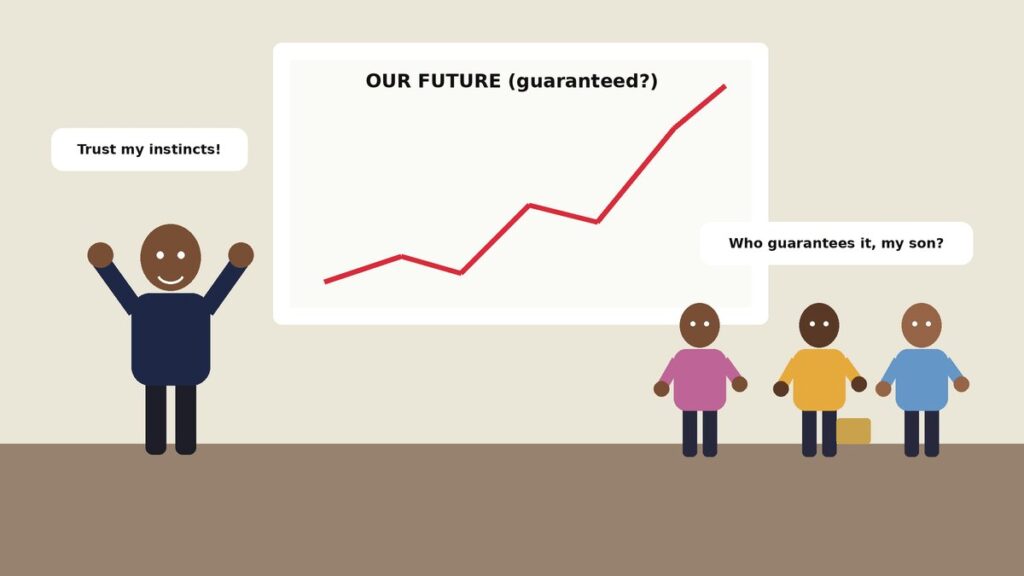
One Friday, Dayo called a meeting. He had a chart. It was a large, hand-drawn picture of a line going up very sharply. At the top, in marker, it said: “OUR FUTURE.”
“My friends,” he said, “I have found a new opportunity. A guaranteed way to triple your money in two months.”
The room went quiet. Chidi leaned forward. Kemi reached for her bag. And Mama Tola, who was visiting and had listened carefully while peeling groundnuts, raised one finger.
“Dayo,” she said gently, “what does ‘guaranteed’ mean?”
“It means certain, ma.”
“And who guarantees it?”
“The, er, people who run it.”
“Who are they?”
“They are… professionals.”
“Do they have a licence?”
The room waited. Dayo scratched his head. “I will find out.”
The Wise Old Lady
Mama Tola put down her groundnuts. “My son,” she said, “I raised six children on a small salary. I have seen many people with beautiful charts. The thing I learned is simple. If someone promises you a sure profit with no risk, hold on to your wallet and ask more questions. Real investments can go up and down. Anyone who says otherwise is selling something.”
It was a short speech, delivered over a bowl of groundnuts, and it landed like a thunderclap. Dayo opened his mouth, closed it again and slowly sat down.
“Maybe I should be more careful,” he said quietly.
“Maybe you should check if your first investment was luck or skill,” said Mama Tola kindly. “Both are possible. But only one will pay you twice.”
The Humble Return
Dayo took the lesson to heart. The next week, he cancelled his big meeting. He tore up the chart and wrote a new one. At the top, it said: “OUR PLAN.” Underneath, in smaller letters, he listed three things. “Save regularly. Learn before you buy. Speak to a licensed adviser.”
He also stopped using words he did not understand. When asked about the market, he replied, “I honestly do not know. I am still learning.” His friends were shocked, and strangely relieved. They liked this new Dayo. He was still cheerful, still ambitious, but now, when he gave advice, he began with the words: “This is just my opinion.”
At the next barbecue, Chidi asked, “So, Dayo, what is the market doing?”
Dayo smiled, took a bite of suya and said, “Same as me. Going up and down, but trying to be wise about it.”
Everyone laughed. It was the best financial advice he had ever given.
This is a work of fiction. It is not financial advice. Before you invest, learn how the product works, be careful with anyone who promises guaranteed returns, and consider speaking to a licensed financial professional.