There are many sacred moments in a Nigerian home. The first spoonful of party jollof. The last piece of meat in the pot. The final five minutes of a big football match. And, somehow, every single time, that is exactly when NEPA decides to take light.
Yes, I know the company changed its name years ago. But when the power goes at the worst possible second, nobody shouts a modern name. We shout the old one, with feeling. This is the story of the Adeyemi family and one very long Sunday evening.
The Setup
Papa Ade had been preparing for this match since Wednesday. He had cleared his schedule, reminded everyone twice that nobody should “disturb the television”, and personally supervised the arrival of pepper soup. His wife, Mama Tolu, had cooked enough rice to feed the entire street, because in her experience a big match attracts neighbours the way an open pot attracts flies.
By the 80th minute the sitting room was full. Papa Ade had the best chair. Uncle Segun sat on a stool pretending he did not want the second-best chair. Little Tolu was on the floor with a bowl, and the neighbours from the next flat stood at the door, politely “just passing”.
The score was level. A free kick was awarded. Papa Ade stood up. Then the television blinked once, twice, and the whole house went dark.
The Sound of Collective Pain
I cannot describe the noise that followed. It was not a scream and it was not a prayer. It was a thing in the middle, like a choir of forty people who had all stepped on the same nail.
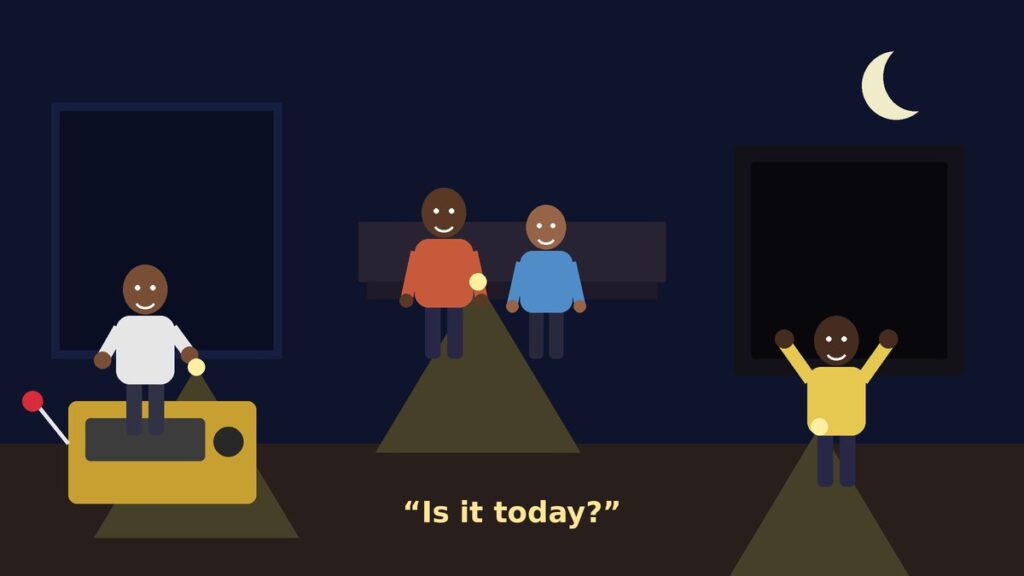
“Ah! Ah! NEPA!” Papa Ade said, to nobody and everybody. “Is it today? Is it today that you will do this thing?”
Uncle Segun, ever the voice of reason, said calmly, “Switch on the generator.”
There was a short silence, the kind that follows a very bad idea. Everyone looked at Papa Ade. Papa Ade looked at the floor.
The Petrol Question
The generator, affectionately called “Small Thunder”, had been sitting in the corner since the previous Tuesday, when it had swallowed the last of its petrol powering a ceiling fan and a single blender. Nobody had bought more. Everyone had assumed somebody else would.
Papa Ade shook the jerrycan. It made a sad little sound, like a spoon in an empty cup. “There is a small small one inside,” he declared with great confidence.
There was not a small small one inside. There was about one mouthful. Still, a man in his own house must try, so he pulled the cord. Small Thunder coughed. He pulled again. Small Thunder sneezed. By the fifth pull the whole sitting room was giving advice in stereo.
“Pull it harder!”
“Don’t pull it like that, you will spoil it!”
“Open the thing on top!”
“Which thing on top?”
At last the generator roared to life, ran for exactly forty seconds, and died with a dignity that suggested it had done its very best.
The Expert Arrives
This was when Mr. Kelechi from the next flat stepped forward. Every compound has one man like him. He owns no tools and holds no certificate, but he speaks about electricity with the calm of a surgeon.
“It is the transformer,” he said, looking at the ceiling as if it had personally insulted him. “I know these things. They will bring it back by nine o’clock.”
It was a quarter past eight. The match had maybe ten minutes left. Papa Ade stared at him. “Nine o’clock? Mr. Kelechi, how do you know?”
“Experience,” said Mr. Kelechi, and nobody argued, because nobody could prove otherwise. In fairness, his record was not terrible. He had once predicted light would return “soon”, and it did, three days later.
Plan B, C and D
Little Tolu suggested using a phone to watch. Good idea, except the family’s three phones were at eleven, nine and four percent, and the data bundle had expired on Friday. Aunty Ngozi, visiting from Enugu, offered her power bank. It was charged to exactly two percent, which she announced with pride, as if she had saved the day.
Uncle Segun tried the radio, which turned out to have no batteries. Then the family discovered that the only batteries in the house were inside the television remote, so they took them out and put them in the radio. The radio crackled and a commentator said, in the voice of a man who had just seen a miracle, “And that is the winning goal!”
Then the batteries died. Nobody knew which team had scored.
The Great Return
For the next twenty minutes the sitting room became a courtroom. Papa Ade claimed his team had won. Uncle Segun claimed the other team had won. Mama Tolu said nobody was getting dessert until they stopped. Mr. Kelechi, still standing by the door, repeated that light would return at nine.
At exactly 8:58 p.m., with no warning, the bulbs flickered and the whole house burst into light. The fridge hummed. The television came back mid-advert for a detergent. Every phone in the building started charging at once, and somewhere down the street a man shouted, “Up NEPA!” with the passion of a football fan.
Papa Ade turned slowly to Mr. Kelechi. Mr. Kelechi adjusted his shirt with great dignity. “Two minutes early,” he said. “I told you. Experience.”
The match had ended long ago. The result? Papa Ade found out from the next-door neighbour’s six-year-old, who walked past the window and cheerfully announced the score, plus who had cried, plus who had been sent off.
What We Learned
Buy petrol before the match, not during it. Charge your power bank before you brag about it. And never trust a man who says he knows when light will return, unless he is wrong in your favour. As for Papa Ade, he now keeps two full jerrycans next to Small Thunder, and a sign in the sitting room that says: “Match day. No light is an emergency.”
Next time NEPA takes light at the worst moment, remember you are not alone. Somewhere, another family is pulling a generator cord and asking the same question: “Is it today?”